Ultrasonic Thickness Gauging
Piezo vs EMAT and How to Pick the Right One
Ultrasonic thickness gauging is one of the most widely used non-destructive testing methods in asset integrity. Two technologies dominate the field: piezoelectric (piezo) UT, the established workhorse, and electromagnetic acoustic transducers (EMAT), an alternative approach that eliminates couplant and opens the door to inspections on hot, coated, and strongly corroded surfaces.
This article compares both technologies side by side, walks through their strengths and trade-offs, and ends with a practical decision framework for matching the right tool to the conditions you actually face in the field. Here is what we cover:
Table of Contents
- Why Thickness Measurement Still Matters
- How an Ultrasonic Thickness Gauge Works
- Piezoelectric UT. The Industry Workhorse
- How piezo transducers work
- Where piezo genuinely excels
- Where the friction starts
- EMAT. Generating Sound Inside the Metal
- How EMAT works
- Why no couplant changes everything
- Permanent magnets vs pulsed electromagnets
- High-temperature capability
- Limitations. Stated plainly
- EMAT in Automated Inspection Solutions
- Other Approaches Worth Knowing
- Choosing the Right Technology. A Practical Framework
- Closing
- References
Let’s start with the basics.
Why Thickness Measurement Still Matters
Aging infrastructure, tighter safety regulations, and shorter maintenance windows have raised the bar on thickness inspection. Routine readings on clean, ambient-temperature steel are still handled well by mature technology.
The readings that matter most today are the hard ones: hot process lines that can't be shut down, coated surfaces where stripping paint costs more time than the inspection itself, corroded steel in confined or elevated positions where every extra step adds risk. These are the inspections that separate a reliable integrity program from one that just checks boxes.

This article walks through the two major ultrasonic thickness gauging technologies in use today, piezoelectric and electromagnetic acoustic (EMAT), and lays out a practical framework for matching the right tool to the conditions you actually face in the field.
How an Ultrasonic Thickness Gauge Works
Most people have heard of ultrasound in the context of medical imaging or parking sensors. In industry, the same physical principle underpins the most widely used method for non-destructive material testing. Ultrasonic thickness gauging lets you measure how thick a wall is from one side only, without cutting, drilling, or taking anything out of service.
The concept behind every ultrasonic thickness gauge is the pulse-echo principle [1]. The instrument sends a short pulse of high-frequency sound into the material. That sound wave travels through the metal at a known velocity, hits the far wall, and bounces back. The gauge measures the round-trip travel time and calculates thickness using a simple relationship:
T = (V × t) / 2
T = material thickness
V = speed of sound in that specific material
t = total time the pulse took to travel there and back
Divide by two because the sound covers the distance twice
Where T is the material thickness, V is the speed of sound in that specific material, and t is the total time the pulse took to travel there and back. Divide by two because the sound covers the distance twice.
The speed of sound varies by material. In carbon steel it runs around 5,920 m/s. In aluminum, roughly 6,320 m/s. The gauge needs to know this value for the material being tested, which is why calibration on a known reference block is standard practice before every job.
The physics are simple. The engineering challenge is in the first step: getting the sound wave into the metal in the first place.
Sound travels well through solids and liquids but barely through air. The acoustic impedance mismatch between a transducer face and an air gap is so extreme that more than 99.9% of the sound energy reflects back before it ever enters the test piece [2]. This is the fundamental problem that every ultrasonic thickness gauge has to solve, and the way it gets solved is where the technologies split.
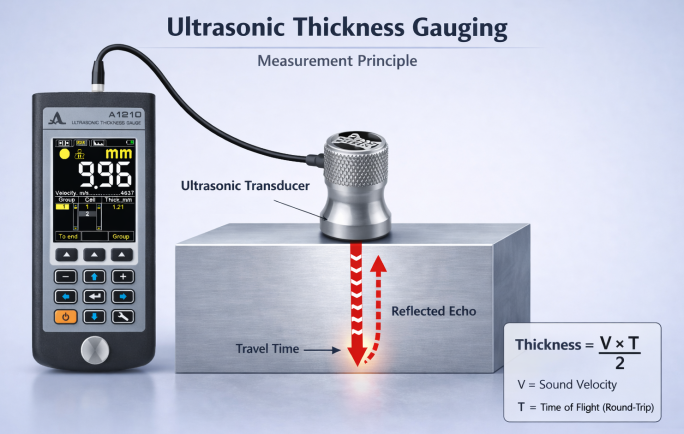
Ultrasonic Thickness Gauging Measurement Principle
Piezoelectric transducers bridge the gap with a liquid couplant, a gel or fluid that fills the space between the probe and the metal surface. EMAT takes a completely different path: it generates the sound wave directly inside the metal using electromagnetic fields, bypassing the air gap entirely.
Both approaches also work with different wave modes. Longitudinal waves (compression waves) are the default for standard piezoelectric gauging. Shear waves, where particles move perpendicular to the wave direction, travel at roughly half the speed and offer higher measurement resolution. EMAT transducers naturally generate shear horizontal (SH) waves, which brings its own set of advantages covered in later sections.
Piezoelectric UT. The Industry Workhorse
How piezo transducers work
Piezoelectric transducers are the foundation of ultrasonic thickness gauging. A polarized ceramic element (PZT) converts electrical pulses into mechanical vibrations and back again. Matching layers optimize energy transfer into the test material. A backing block dampens ringing to keep the pulse short and the resolution high.
The one non-negotiable requirement is couplant. A thin film of gel, glycerin, or oil must fill the air gap between the probe face and the metal. Without it, the sound never enters the material.
For thickness work, the most common configurations are:
- Single-element probes for general-purpose measurement on smooth surfaces
- Dual-element probes with separate transmit/receive crystals angled to create a focused zone, the standard choice for corrosion surveys on rough or pitted metal
- Delay-line probes with a plastic standoff for thin-wall measurement and high-temperature work
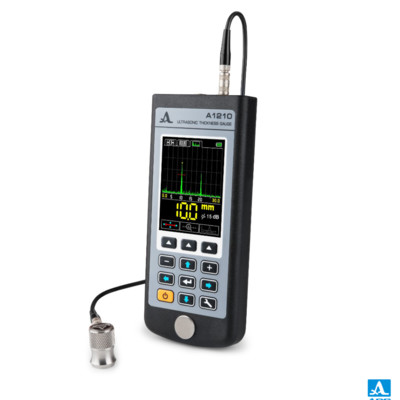
ACS offers a range of piezoelectric thickness gauges covering all three configurations, from the pocket-sized A1207 PenGauge to the A1210 with full A-scan display. Each is built for a different inspection workflow.
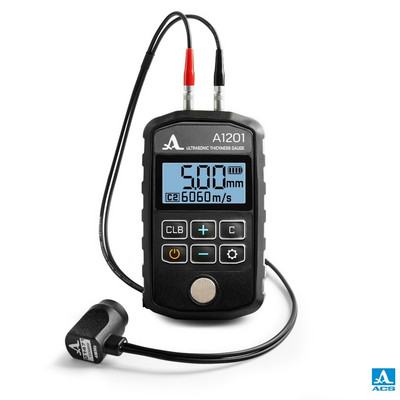

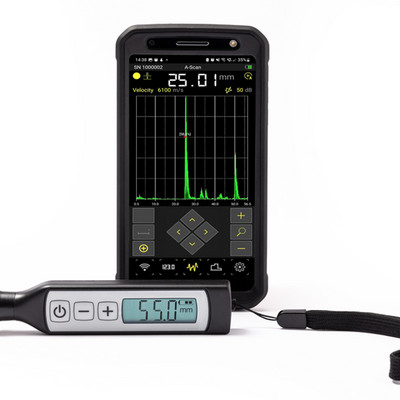
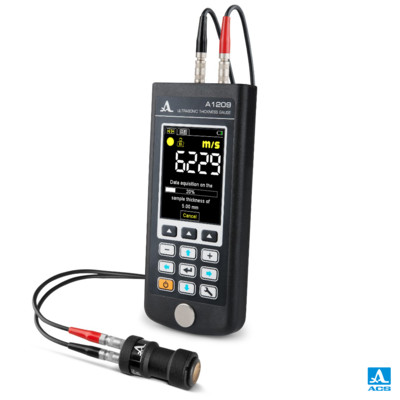
Where piezo genuinely excels
Piezo has earned its place as the default for good reasons:
- Best absolute accuracy
On clean, ambient-temperature surfaces. Resolution down to 0.01 mm is routine. - Lowest cost per reading
Affordable instruments, interchangeable transducers, and consumables that amount to a bottle of gel. - Widest material compatibility
Metals, plastics, composites, glass, ceramics. For non-metallic materials, piezo is often the only practical option. - Massive installed base
Every NDT technician on the planet has trained on piezo equipment. No learning curve, no shortage of qualified operators.
.png)
Material Penetration across materials
These ranges assume standard contact transducers with appropriate frequency selection. Higher frequencies resolve thinner walls; lower frequencies push deeper into attenuative materials like cast iron.
Where the friction starts
The limitations all trace back to one thing: the couplant and the surface it has to sit on.
- Couplant dependency.
Gel drips off vertical surfaces, freezes in sub-zero conditions, boils on hot steel, and contaminates food-grade or pharmaceutical environments. Over thousands of measurement points, the seconds spent applying and cleaning it compound into hours. - Surface preparation.
Piezo probes need reasonably smooth, clean metal. Loose paint, heavy rust, mill scale, weld spatter all have to go before the first reading. On a large pipeline or tank floor, grinding and brushing can take longer than the inspection itself. - Temperature ceiling.
Standard probes degrade above roughly 50°C. Specialized high-temp delay lines push the range to about 500°C, but require brief-contact technique, constant re-zeroing, and couplants that still burn off quickly. Every reading becomes a race against thermal damage.
Behind all of these constraints is a single physical fact: more than 99.9% of acoustic energy reflects at a steel-air interface [2]. Couplant exists to solve that problem. Removing it from the equation requires a fundamentally different way of generating the sound wave, which is exactly what EMAT provides.
EMAT. Generating Sound Inside the Metal
How EMAT works
Every EMAT probe relies on two active components: a magnet that establishes a magnetic field inside the metal, and an RF coil that sits just above the surface.
When the coil fires an alternating current in the ultrasonic frequency range, it induces eddy currents in the skin layer of the metal beneath it. Those eddy currents interact with the magnetic field, producing a Lorentz force that physically shakes the crystal lattice of the material [3]. That mechanical disturbance is your ultrasonic wave. On the return trip, the back-wall echo reverses the process and induces a small voltage in the same coil. The Lorentz force mechanism works on any electrically conductive metal, including aluminum, copper, and stainless steel.
In ferromagnetic metals like carbon steel and cast iron, there is a second mechanism working in parallel. Magnetostriction, the tendency of magnetic domains to change shape under an applied field, adds significant signal strength on top of the Lorentz force [4]. This is why EMAT signals are typically stronger on carbon steel than on aluminum. The combined result is a crisp echo without a drop of couplant.
The key insight is that the material itself becomes the transducer. The sound wave is born inside the metal, not pushed in from outside through a layer of gel. There is no air gap problem to solve.
Why no couplant changes everything
Removing couplant is not just a convenience upgrade. It eliminates the single biggest bottleneck in field thickness inspection.
- Coated surfaces.
EMAT reads through paint, primer, epoxy, and light corrosion up to about 3 - 4 mm thick. The display shows metal thickness only. No stripping, no grinding. - Corroded and scaled metal.
Rust, mill scale, and oxidation layers that would block a piezo probe are largely transparent to EMAT. - Corrosion under insulation (CUI).
Surveys can proceed without removing cladding or weather jacketing, cutting scaffolding time and exposure risk. - Hot surfaces.
No couplant to boil off. EMAT probes operate on steel at temperatures up to 800°C, with some configurations reaching 1,000°C. - Contamination-sensitive environments.
No gel residue left on the surface. Relevant for food processing, pharmaceutical, and cleanroom applications. - Speed.
Touch the probe to the surface, get a reading. No prep, no cleanup. Typical inspection speed is roughly double that of piezo on comparable assets.
Signal strength does decrease as the gap between the probe and the bare metal grows. The chart below shows how coating thickness affects the returned signal amplitude.
.png)
Signal Amplitude vs Standoff: how coating thickness affects signal strength
At 3 mm of coating, the signal still retains enough strength for reliable thickness readings. Beyond that, accuracy starts to drop off. This is the practical boundary for through-coating measurement with current EMAT instruments.
Permanent magnets vs pulsed electromagnets
Early EMAT probes used permanent neodymium (NdFeB) magnets to create the bias field. They worked, but they introduced their own set of problems on ferromagnetic steel.
The issues with permanent magnets:
- Extreme magnetic drag. The probe clamps onto the steel surface so hard that inspectors can’t slide it [5]. Continuous scanning becomes impossible. Every reading turns into a point-by-point lift-and-place exercise.
- Debris attraction. Metal shavings, scale, and dirt stick to the magnetized face constantly, degrading signal quality and requiring frequent cleaning.
- Thermal vulnerability. NdFeB magnets have a relatively low Curie point. They lose magnetization at elevated temperatures, making them unreliable on hot assets without bulky cooling systems.
The solution – pulsed electromagnets
A pulsed electromagnet replaces the permanent magnet with a wound copper core. The instrument fires a short, intense DC pulse through the electromagnet at the exact moment the RF coil sends its acoustic pulse. The magnetic field is only active for a fraction of a millisecond during the actual measurement.

Pulsed EMAT: the magnetic field is only active during the measurement pulse
Understanding the role of magnets is important because the type of magnet directly impacts the transducer’s application range, portability, and power requirements. Here is how the three main approaches compare.
The Role of Magnets in EMAT
An EMAT consists of a coil and a magnetic field generator. The type of magnet used profoundly impacts the transducer’s application, portability, and power.
Utilizes Neodymium (NdFeB) to provide a constant magnetic field.
- Portability: High
- Power Requirements: Low
- High Temp Duty: Limited
Uses a coil driven by DC or low-frequency AC to induce a field.
- Field Adjustment: Variable
- Size / Weight: Bulky
- Continuous Duty: Excellent
Delivers short, extremely high-current pulses for massive temporary fields.
- Peak Field Strength: Maximum
- Thermal Build-up: Low
- Electronics Complexity: High
What this means in practice:
- No magnetic drag. The probe is unmagnetized 99.9% of the time. Inspectors can glide it smoothly across the surface for continuous B-scan profiling.
- No debris attraction. The sensor face stays clean. Consistent liftoff distance, consistent readings.
- No thermal degradation of magnets. There is no permanent magnet to lose its properties at high temperature.
- Tunable output. Engineers can adjust the pulse voltage to optimize signal strength for different materials and wall thicknesses, something a fixed permanent magnet can’t do.
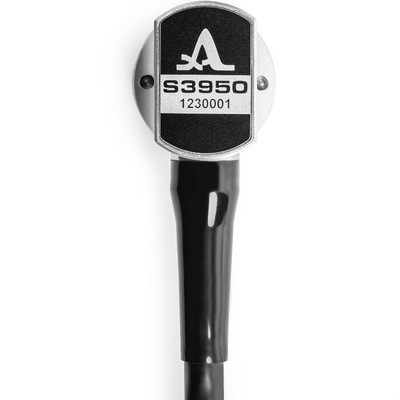
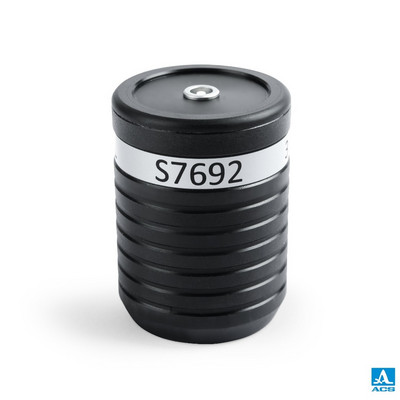
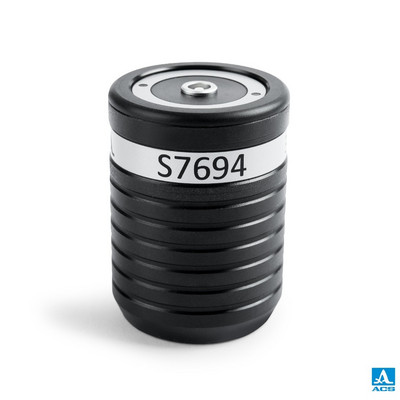
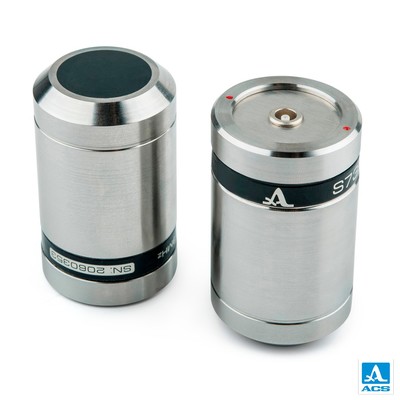
ACS builds EMAT transducers in both configurations. The S3950 probe uses pulsed magnetization with an integrated cable. The S7692, S7694, S7392, and S7394 probes use permanent magnets for applications where magnetic drag is not a concern, such as fixed-point measurements or lighter alloys.
EMAT transducers: Full EMAT transducer range
High-temperature capability
Standard ultrasonic couplant boils at around 150°C. Specialized high-temperature gels push the limit to roughly 300°C with brief contact technique. Beyond that, piezo gauging becomes impractical.
EMAT operates in a different range entirely. The ACS A1270 with its high-temperature transducer (S73 series) delivers stable readings on surfaces up to 800°C. Some research configurations have reached 1,000°C.
This is not an incremental improvement over piezo. It is a different operational category. It means measuring wall thickness on live refinery distillation columns, boiler water-walls under full steam load, hot-rolled steel on the mill line, and chemical process piping that cannot be taken offline. Jobs that previously required a shutdown or a cooling window can now be inspected during normal operation.
Limitations. Stated plainly
EMAT is not a universal replacement for piezo. It has boundaries that matter.
- Material compatibility.
EMAT only works on electrically conductive and ferromagnetic materials. Plastics, composites, glass, and ceramics are outside its range. For those, piezo is the only option. - Signal-to-noise ratio.
EMAT signals are inherently weaker than piezo signals. In certain conditions, particularly heavy pitting corrosion, this can affect readability. Modern amplifiers and smart gating compensate in most scenarios, but the gap exists. - Minimum thickness.
The RF excitation pulse creates a first-echo dead zone of roughly 6 mm in steel, meaning the gauge cannot measure from the initial pulse alone at that range. However, modern instruments bypass this using echo-to-echo timing and advanced signal processing. The ACS A1270, for example, measures down to 0.9 mm on steel [6]. The dead zone is a physics characteristic of the method, not a hard instrument limitation. - Frequency range.
EMAT operates at lower frequencies than high-frequent piezo-transducers, which limits its precision on very thin or finely layered materials where high-frequency resolution is needed. - Single element configuration only.
EMAT cannot implement a dual-element probe, which limits its detection performance on some corrosion arts, such as pitting. - Instrument cost.
EMAT gauges cost more than basic piezo instruments. The economics work out when prep time, consumables, downtime savings, and access costs are factored in, but the upfront price is higher.
Engineers respect honesty about trade-offs. Every technology has a working envelope. EMAT’s envelope covers the conditions where piezo struggles most.
EMAT Thickness Gauging in Automated Inspection Solutions
Handheld EMAT gauges solve the access and surface prep problems for field inspectors. But the same physics that make EMAT work without couplant also make it a natural fit for automated and robotic inspection systems.
Conventional piezo automation is possible, but it requires constant couplant delivery. That means fluid reservoirs, pumps, nozzles, and recovery systems, all adding weight, complexity, and failure points to an automated rig. If the couplant feed dries up mid-scan, the data stops. If it floods unevenly, the readings drift.
EMAT removes that entire subsystem. No fluid to supply, no mess to recover. The probe just needs proximity to the metal surface and an electrical connection. That simplicity translates directly into more reliable continuous scanning.
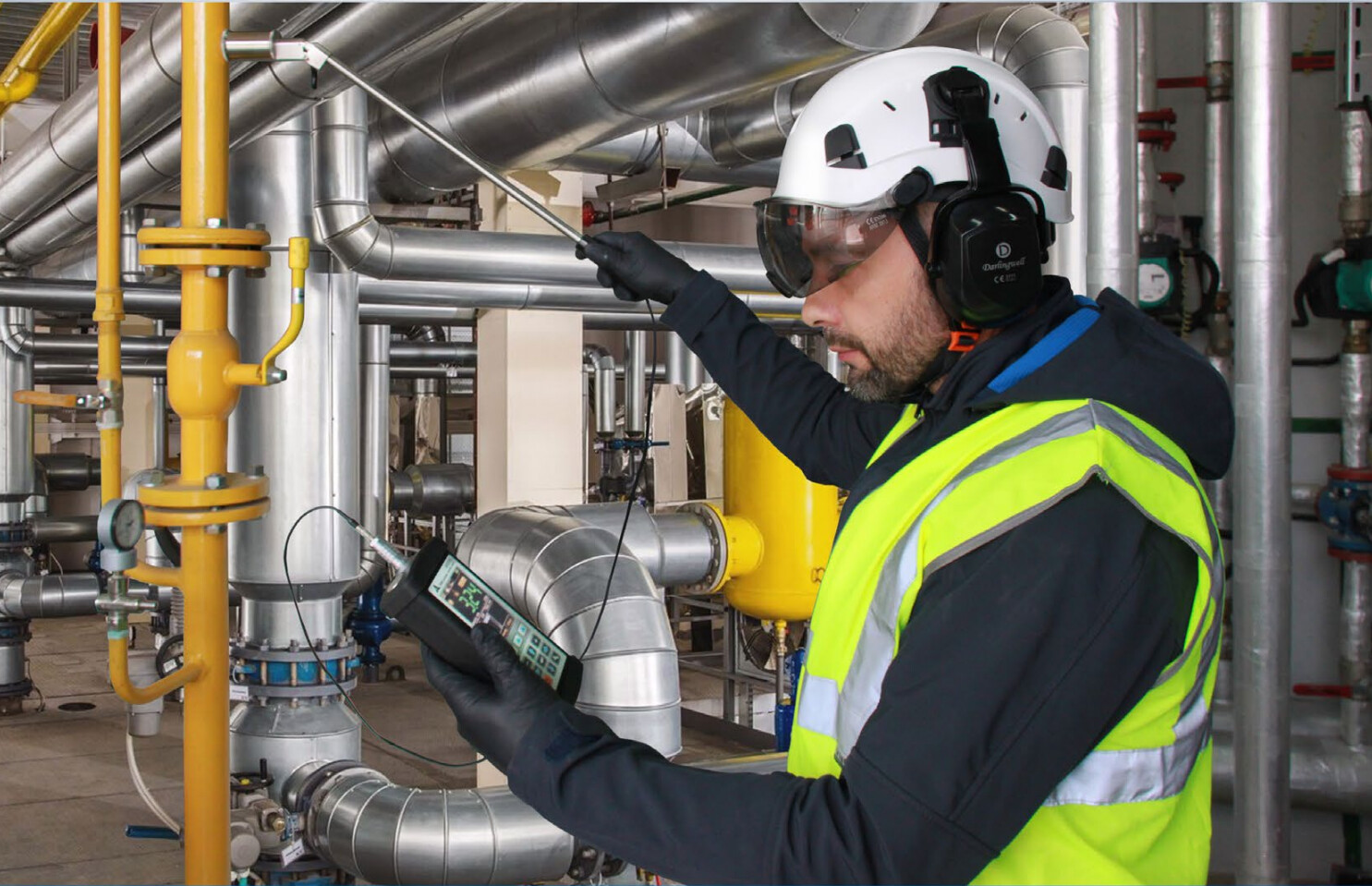
Pulsed electromagnet probes are especially suited to automation. Because the magnetic field is only active during the measurement pulse, the probe doesn’t stick to ferromagnetic surfaces. A robotic crawler or motorized carriage can glide the sensor smoothly without fighting magnetic drag, producing clean B-scan wall profiles over long runs.
Where this matters most:
- Boiler water-wall inspection.
Automated EMAT rigs scan hundreds of tubes per shift without scaffolding crews applying and cleaning couplant at every point. - Storage tank floors.
Crawlers map remaining wall thickness beneath epoxy or bitumen coatings without stripping them first. - Inline pipe mills.
EMAT integrates into production lines for real-time wall thickness verification during manufacturing, at speeds that contact probes can’t match. - Offshore and confined-space assets.
Robotic platforms carry EMAT sensors into places where sending a human inspector is expensive, slow, or hazardous [7][8].
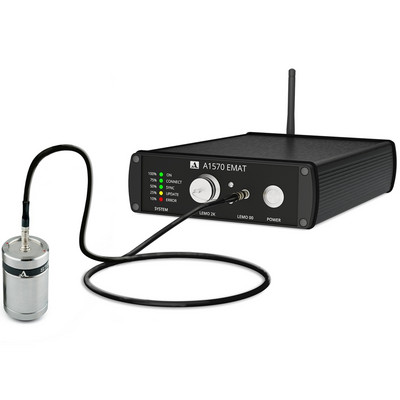
The ACS A1570 EMAT is purpose-built for this role. It is an OEM pulser-receiver unit designed for integration into third-party scanning systems and automated inspection rigs. It supports both pulsed magnetization and permanent magnet transducers, with bipolar burst excitation across a 1 to 10 MHz frequency range. Data interfaces include Ethernet and WiFi, with an SDK compatible with the SCPI industrial protocol for straightforward integration into mapping software and reporting systems.

Other Approaches Worth Knowing
Piezo and EMAT cover the vast majority of industrial thickness gauging, but they share a common constraint: both work best within a certain frequency and penetration range. When the material is extremely thick, highly attenuative, or not metallic at all, a different class of transducer steps in.
Dry-Point-Contact (DPC) transducers operate at much lower frequencies, typically between 20 kHz and 400 kHz. Instead of a flat wear face and couplant, they use a spring-loaded point or pin that presses directly against the surface, mechanically coupling low-frequency acoustic energy into the material without any liquid.
That low frequency is what gives DPC its reach. Where standard piezo and EMAT signals attenuate and scatter in thick or granular materials, DPC pushes through. Inspection ranges can extend from several hundred centimeters to several meters, making it practical for applications that would be invisible to higher-frequency methods.
Where DPC finds its niche:
- Heavy-gauge steel plate too thick for conventional UT frequencies
- Concrete structures where ultrasonic monitoring of thickness or crack depth is needed
- Wood and timber in structural assessment
- Highly attenuative composites and cast materials with coarse grain structures
The trade-offs are straightforward. Low frequency means lower resolution, so DPC cannot match the fine detail of piezo or EMAT on standard metal walls. The equipment is more specialized, the application scope is narrower, and it does not replace either technology for routine metal inspection. It fills a gap that neither piezo nor EMAT was designed to reach.


DPC Transducers array devices
ACS produces a range of DPC transducers and transducer arrays in its catalog, covering frequencies from 20 kHz upward for integration with compatible flaw detectors and thickness gauges.
Choosing the Right Technology. A Practical Framework
There is no single best ultrasonic thickness gauge. There is only the right one for the conditions in front of you. The chart below captures the broad performance profile of each technology. EMAT pulls ahead on surface tolerance, couplant independence, high-temperature range, and automation speed. Piezo leads on transduction efficiency and material versatility. Neither wins everywhere.

EMAT vs Traditional UT: performance comparison
It is important to interpret the performance comparison visual as a specific profile highlighting relative strengths, rather than a depiction of overall market usage or frequency.
While EMAT demonstrates distinct capabilities for those extreme-condition challenges, Traditional Piezo UT remains the industry’s predominant and most broadly applied tool.
It’s the reliable daily driver and has been the proven established standard for standard, everyday ultrasonic inspections across countless diverse sectors for decades. For the overwhelming majority of common inspections, where those extreme conditions are not present, it is still the preferred choice.
Consider EMAT your powerful niche specialist, and Piezo your go-to reliable workhorse.?
The questions below walk through the decision in the order that usually matters most on a real job.
What is the surface temperature?
If the surface is above 150°C, standard piezo couplant is out. Specialized high-temp piezo probes extend the range to about 500°C with brief contact, but they add complexity. Above 500°C, EMAT is the practical choice. The A1270 with the S73 series transducer handles surfaces up to 800°C without couplant or cooling.
Is the surface coated, corroded, or scaled?
If the answer is yes and you don’t want to strip it, EMAT is the shorter path. It reads through paint, primer, and light corrosion up to about 4 mm. Piezo can work on coated surfaces with through-paint measurement mode, but it still needs couplant and a reasonably smooth finish underneath.
Is couplant practical in this environment?
Some situations rule out gel entirely. Production lines where liquid contamination is not acceptable.
Remote locations where consumable resupply is a logistical problem. Confined spaces where cleanup is difficult.
Cleanroom or food-grade environments. In any of these, EMAT’s couplant-free operation is not just convenient, it is necessary.
Do you need continuous scanning or spot checks?
For spot checks on accessible surfaces, either technology works well. For continuous scanning, especially on ferromagnetic steel, pulsed electromagnet
EMAT has a clear advantage. No magnetic drag, no couplant trail, smooth B-scan profiling along the surface.
What material are you inspecting?
This is where piezo has exclusive territory. EMAT requires an electrically conductive material,
and works best on ferromagnetic metals. If you are measuring plastics, composites,
glass, ceramics, or certain non-ferrous alloys with low conductivity, piezo is the only option.
What does the budget and team capability look like?
For standard corrosion surveys on clean, accessible, ambient-temperature steel, piezo gauges deliver excellent results at the lowest cost.
The instruments are less expensive, the transducers are widely available, and the technique is familiar to every trained NDT operator. When the conditions get harder, the cost equation shifts. Time saved on surface prep, eliminated consumables, reduced scaffolding, and avoided shutdowns add up quickly. In those scenarios, the higher upfront cost of an EMAT gauge pays back within the first major campaign.
The answers to these questions tend to sort themselves naturally. Piezo for the standard conditions. EMAT for the tough ones. Both in the toolkit for full coverage.
.png)
Decision Matrix: Selecting the Right Technology
Closing
The tools exist to match the conditions. The question was never piezo or EMAT. It was always about the job in front of you.
When the surface is clean, the temperature is ambient, and the material could be anything from steel to plastic, a piezo gauge remains the most practical and cost-effective choice. When the conditions push back, hot metal, coated surfaces, corroded pipes, limited access, no time for prep, that is where EMAT earns its place.
ACS builds both. The A1207 through A1210 piezo gauges cover standard thickness measurement across a wide range of materials and applications. The A1270 EMAT handles the inspections that used to require shutdowns, grinding crews, and temperature windows. The A1570 EMAT OEM brings the same capability into automated systems and robotic platforms.
If you are evaluating which technology fits your inspection program, we are happy to talk it through.
References
[1] "Ultrasonic Testing of Materials", 4th fully rev. ed., J. Krautkrämer and H. Krautkrämer, Springer-Verlag, Berlin, Germany, 1990.
[2] "Acoustic Impedance", Innovation.world. Available: https://innovation.world/invention/acoustic-impedance/
[3] "Application of Electromagnetic Ultrasonic Testing Technology in Pipeline Defects", Coatings, vol. 16, no. 1, 2026. Available: https://www.mdpi.com/2079-6412/16/1/133
[4] "Influence of Magnetostriction Induced by the Periodic Permanent Magnet Electromagnetic Acoustic Transducer (PPM EMAT) on Steel", ResearchGate, 2021. Available: https://www.researchgate.net/publication/356398045
[5] "A Lorentz Force EMAT Design with Racetrack Coil and Periodic Permanent Magnets for Selective Enhancement of Ultrasonic Lamb Wave Generation", PMC, 2023. Available: https://pmc.ncbi.nlm.nih.gov/articles/PMC9824448/
[6] "Thickness Measurements with EMAT Based on Fuzzy Logic", Sensors, PMC, 2024. Available: https://pmc.ncbi.nlm.nih.gov/articles/PMC11244354/
[7] "Development of an Ultrasonic Inspection Robot Using an Electromagnetic Acoustic Transducer for a Lamb Wave and an SH-plate Wave", ResearchGate, 2004. Available: https://www.researchgate.net/publication/8654256
[8] "Towards Guided Wave Robotic NDT Inspection: EMAT Size Matters", ResearchGate, 2019. Available: https://www.researchgate.net/publication/338200961
Need Help Choosing the Right Technology?
If you're evaluating which technology fits your inspection program, our engineering team is happy to talk it through.